
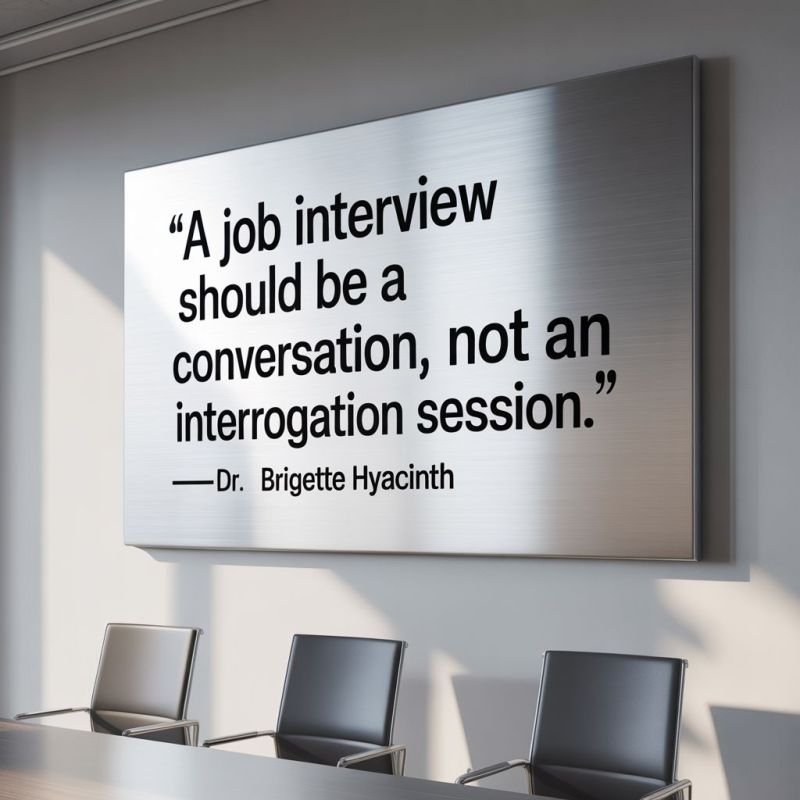
The most compelling candidates in an interview aren’t the most qualified ones. They’re the ones who seem like they might say no.
I’ve spent more than 20 years hiring in tech, and the best interviews I’ve ever sat in didn’t feel like interviews at all. They felt like two people figuring out whether they could build something good together. Nobody performed. Nobody interrogated. Both sides stayed genuinely curious. That difference comes down to one thing: your interview mindset. The candidate who walks in hoping to get picked behaves differently from the candidate who walks in deciding whether this is the right fit, and hiring managers feel that gap within the first few minutes.
Why the “please hire me” interview mindset backfires
Here’s the thing about walking into a room hoping they’ll like you: you shrink. You reach for safe answers, and you give rehearsed responses that sound fine but reveal nothing. So you leave without ever showing them who you actually are, and they leave without a reason to fight for you.
This is the weakness position, and it’s the default for most people in a tough market. When you believe you need them more than they need you, every choice gets smaller. You hedge, you over-explain, you laugh a little too quickly at their jokes. None of it is lying. It’s just fear leaking into the room, and fear reads as risk. Because a hiring manager’s real job is to reduce risk, a nervous candidate hands them exactly the wrong signal.
Walk in as the buyer, not just the seller
The fix isn’t confidence theater. You don’t need to fake swagger or pretend you have ten offers. Instead, change what you’re actually doing in the room. You’re not only auditioning for them – you’re evaluating them right back.
Remember why this role exists: something on their side is broken, missing, or growing faster than they can handle. They need it filled, with a gap, a deadline, and a budget attached. You’re a candidate solution to a real problem, not a supplicant. In fact, the people running the interview are coached to treat it as a mutual evaluation too, as Harvard Business Review lays out for hiring managers. When you hold that frame, your search comes from a position of strength rather than weakness, and everything downstream gets easier: better questions, more honest answers, far less anxiety.
The reframe I give clients is simple. The candidate who might say no is the one they’ll fight to keep. Scarcity is persuasive, because we all want what we might not get. You don’t manufacture that by playing games, though. You earn it by genuinely treating the conversation as a two-way decision.
Three questions that flip your interview mindset
Talk is cheap, so here’s how you actually show up as an evaluator. Ask the questions only a serious buyer would ask. These three do real work:
- “What does success look like in the first 90 days, and who decides whether I hit it?” This signals you think in outcomes, not tasks. It also tells you whether the role has a clear definition of done or whether you’d be chasing a moving target.
- “What’s the hardest part of this job that isn’t in the description?” Every role carries a hidden tax. Asking about it shows you’ve been around the block, and the answer tells you what you’d really be signing up for.
- “Why is this role open, and what happened to the person who had it last?” A confident manager answers this cleanly. A vague or defensive answer is data too – sometimes the most useful data you’ll collect all day.
Notice that none of these are gotcha questions. Instead, they’re the questions of someone deciding whether to take the job, not someone begging for it. That subtle shift is the same muscle behind becoming the obvious hire: you stop performing and start fitting.
Build your evaluation checklist before you walk in
You can’t evaluate them if you haven’t decided what matters to you. So do the homework most candidates skip, and write down your own non-negotiables before the interview. Three buckets work well:
- The work. What problems do you want to be solving a year from now, and which of them does this role actually involve?
- The manager. How do they handle disagreement, deadlines, and credit? You’re going to spend more waking hours with this person than with most of your family.
- The trajectory. Where does this role lead, and does that direction match where you’re trying to go?
Keep it to one page. During the interview, you’re quietly checking boxes – not to be cold, but to stay honest with yourself when the rush of an offer tempts you to wave off red flags. Plenty of smart people talk themselves into the wrong job because they never wrote down what the right one looked like. And if the culture feels off in the room, trust that signal; I’ve watched too many clients ignore it and land in a subtly toxic workplace they could have screened out up front.
End like an equal with a graceful handoff
When the interview winds down, most candidates either trail off or gush. Neither helps. Instead, close with what I call a graceful handoff, where you hand the conversation back on your own terms. Try something like: “This has been useful for me. Based on what I’ve heard, I’m confident I could fix [specific problem] here. What would you want to see from me to feel good about that?”
That one move does three things at once. It restates your value, it signals you’re still evaluating fit, and it invites them to start selling you. Notice the posture – you’re not asking whether you passed, because you’re treating the next step as a shared decision. By the way, this same position-of-strength frame is what keeps money on the table once an offer lands, which is exactly why I tell people to negotiate every offer instead of grabbing the first number out of relief.
None of this requires you to be the smartest person in the room. Rather, it requires you to stop performing and start deciding. Shift your interview mindset from “please pick me” to “let’s find out if this is right,” and you’ll be surprised how often they’re the ones working to convince you.
What to do next
If you want to know what the delay is actually costing you, run the job search cost assessment. Ninety seconds, and it gives you a monthly dollar figure plus the stage of your search that’s costing you the most.
If you want the exact questions to size up the person you’d report to, read Interview the Manager: 4 Questions to Ask Before You Accept next.
If you’d rather have someone pressure-test your interview approach and tell you what to fix first, book a free strategy call.