
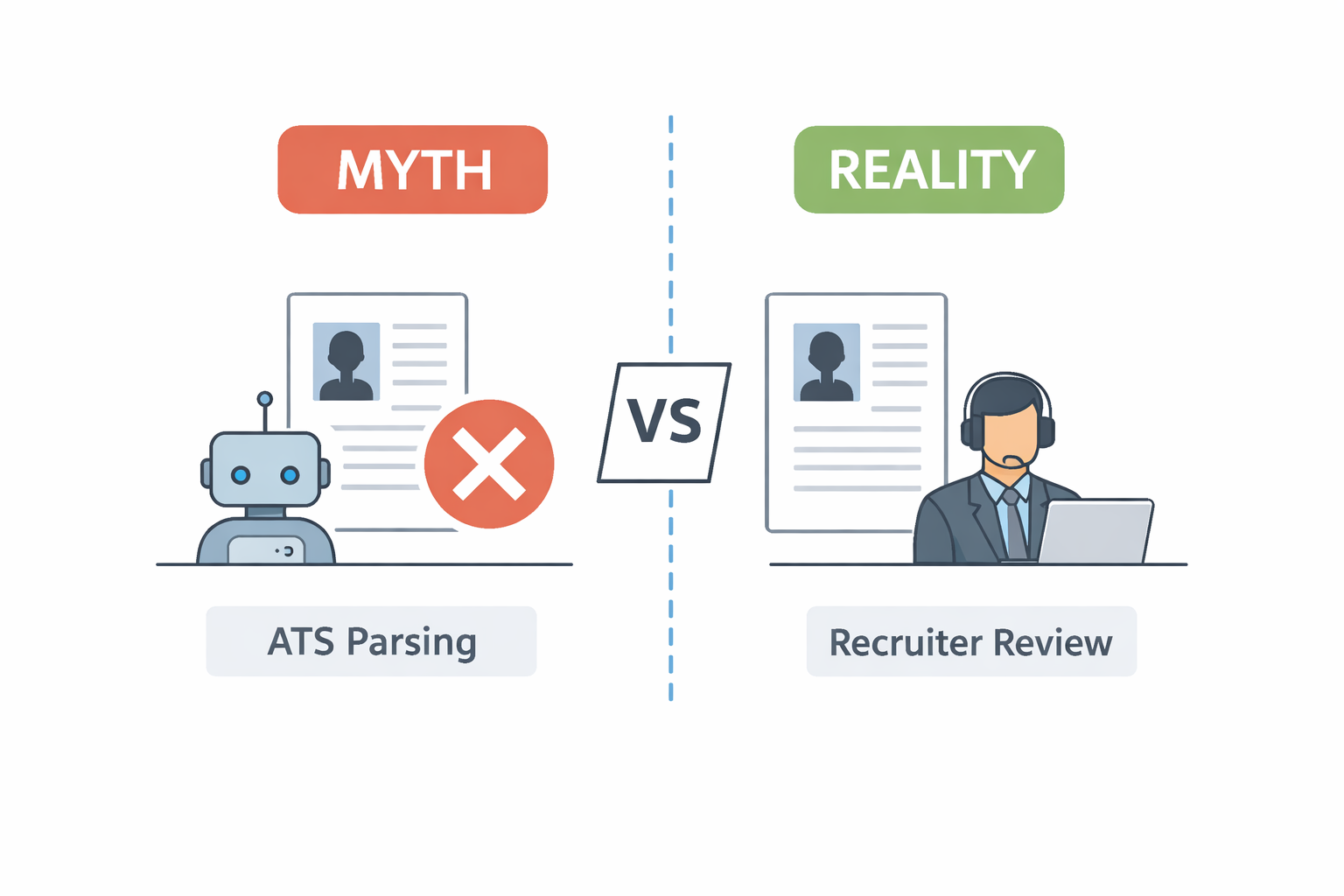
Stop Trying to Beat the ATS. Make Your Resume Easy to Say “Yes” To.
 You’ve probably heard some version of this:
“Most resumes never get read by a human.”
And if you’re job searching, that idea lands like a punchline nobody asked for.
Here’s the problem: that stat gets thrown around like gospel, but it’s often recycled from articles that don’t actually show supporting research. It sticks because it’s simple, scary, and it gives people something to blame.
But the truth is way more useful:
Most resumes that don’t move forward fail for the same reason most products don’t sell – the value isn’t clear fast enough.
The resume boogeyman we keep feeding
When the job search feels unfair, your brain will grab onto a clean explanation.
-
“It’s the ATS.”
-
“It’s the algorithm.”
-
“It’s because I used the wrong template.”
Sometimes the system is messy. Sometimes it is competitive. Sometimes recruiters are overloaded.
But the ATS-as-villain story often distracts from the two levers you can control today:
-
Can the system read your resume cleanly?
-
Can a human understand your fit in 10 seconds?
If you nail those, you’re not “beating” anything. You’re making it easy for the right person to pick you.
What an ATS actually does (in plain English)
An ATS is basically a company’s filing cabinet + workflow tool.
It helps them:
-
collect applications
-
store resumes
-
search and filter candidates
-
move people through stages (screen, interview, offer, etc.)
Yes, some setups include knock-out questions (work authorization, location, required certification). And some teams use keyword searches or filters to manage volume.
But most hiring processes still involve humans reviewing resumes – especially for roles where the cost of a bad hire is high (which is most roles).
Translation: your goal isn’t to outsmart a robot.
Your goal is to be findable, readable, and obviously relevant.
The real funnel that matters: Recruiter – not robot
Here’s the part people miss:
Even if 100 people apply, it’s rarely the hiring manager reading 100 resumes. Usually, a recruiter (or recruiting team) is doing the first pass and sending a smaller set forward.
So if you want to improve your odds, optimize for the person doing the first pass:
-
They’re scanning fast.
-
They’re matching to requirements.
-
They’re looking for proof, not promises.
If your resume makes them work to connect the dots, they move on. Not because they’re cruel – because they’re busy.
The “3R Resume” framework: Readable, Relevant, Evidenced
I like frameworks because they calm the chaos. This one is simple and it works across industries:
Readable: don’t make the software guess
If your resume is hard to parse, you’re creating unnecessary risk.
Keep it boring in the best way:
-
Use standard section headings (Summary, Experience, Education, Skills)
-
Stick to one column
-
Avoid tables, text boxes, and icons that carry meaning
-
Don’t use images to display text (logos, fancy headers, skill bars)
-
Use consistent formatting for titles, companies, dates
Think of this like product usability. If the interface is confusing, users bounce.
Relevant: match the job – without keyword soup
Hiring teams are not looking for “good people.” They’re looking for this person for this job.
Relevance is not stuffing keywords. Relevance is alignment.
Do this:
-
Mirror the job title when it fits your actual target
-
Use the language of the job description where it’s true for you
-
Prioritize the most relevant achievements near the top of each role
-
Build two resume versions if you’re targeting two different role families (example: Product Manager vs Customer Success Leader)
Don’t do this:
-
copy-paste a skill list that reads like a software license agreement
-
claim every keyword if you can’t back it up in interviews
-
bury your best, most relevant work under older, less related roles
Evidenced: prove it with outcomes
“Led cross-functional initiatives” is fine.
“Led a cross-functional initiative that reduced onboarding time by 50%” gets interviews.
If your bullets don’t show outcomes, you’re asking the recruiter to assume you’re strong.
A simple bullet formula:
Action + What you did + Why it mattered + Proof
Examples:
-
Improved customer retention by rebuilding onboarding, reducing time-to-value from 30 days to 14 days
-
Increased qualified pipeline by partnering with Sales on a new lead scoring model, lifting conversion by 18%
-
Shipped a new search experience that improved conversion rate and increased bookings quarter over quarter
Your resume shouldn’t be a list of responsibilities. It should be a list of business problems you’ve solved.
Quick self-test: will your resume parse cleanly?
Try this before you apply anywhere:
-
Open your resume PDF
-
Select all (Ctrl + A / Cmd + A)
-
Copy and paste into a plain text doc
-
Scan for weird spacing, missing sections, scrambled dates, or bullets turning into chaos
If the pasted version is readable and in the right order, you’re probably in good shape.
If it’s a mess, simplify formatting until it isn’t.
This is not glamorous advice. It’s effective advice.
Common “ATS myths” that waste your time
Let’s save you a few hours (and maybe a few dollars).
Myth 1: “ATS automatically rejects 75% of resumes”
In reality, most filtering happens because of fit, requirements, and human decision-making under time pressure.
Myth 2: “This one template beats every ATS”
There are tons of ATS tools and configurations. Anyone promising a universal cheat code is selling confidence, not certainty.
Myth 3: “More keywords = more interviews”
Keyword stuffing can backfire. If your resume reads like a search engine wrote it, you look less credible, not more.
Myth 4: “Your resume gets you hired”
Your resume gets you a conversation. You get you hired.
A plug-and-play checklist before you hit Apply
Use this as your two-minute pre-flight check:
Formatting (Readable)
-
Single column
-
No tables or text boxes
-
No icons or charts that replace words
-
Dates, titles, and companies are consistent
-
PDF exports cleanly and copy/paste works
Alignment (Relevant)
-
Target role is obvious in the first 10 seconds
-
Top 3 requirements appear in your Summary or first role
-
Your most relevant wins are near the top
-
You’re not applying to two different job families with one resume
Proof (Evidenced)
-
At least half your bullets include measurable outcomes
-
Every bullet answers “so what?”
-
You can tell the story behind your top 3 bullets in an interview
FAQ: The questions I hear every week
Should I apply with PDF or Word?
Most of the time: PDF is the safest for consistent formatting. If an application explicitly requests Word, follow instructions.
Are two-page resumes okay?
If you have 10+ years of relevant experience, yes. Clarity beats arbitrary page limits.
Do I need a different resume for every job?
Not necessarily. But you often need different versions for different role types or seniority levels.
What if I’m pivoting careers?
Then your resume needs to do more explaining. You can’t assume the reader will connect the dots. Lead with transferable proof and a clear narrative.
Want a resume that gets responses from humans?
If you’re tired of guessing and you want a resume that:
-
reads cleanly in systems,
-
makes your fit obvious fast, and
-
gives you strong interview stories to back it up,
that’s exactly what I do in my coaching.
(And no – I won’t sell you a magic template. I’m not a wizard. I’m just annoyingly practical.)